
In high school, I worked on the student newspaper. At some point, I had managed to get tickets to a taping of Saturday Night Live, which was a pretty big deal to me, so I wrote an article about the experience and included instructions for how other people could get tickets. This was before you could just Google this stuff, so the most useful piece of information was an address you had to write to.
After the newspaper came out, I started finding copies lying around school with the address torn out. I loved that. People had actually read something I made and found it useful enough to rip a piece of it out and put it in their pocket. I don’t remember anything else I wrote for the newspaper, and I don’t know if anyone ever actually got SNL tickets, but I remember those little missing rectangles.
I think I’ve always liked making things people can hold. Years later, we had an amazing Ghost Robot office in Williamsburg. We moved there in 2012, when moving a creative company to Williamsburg still felt like a bold decision. It was on the ground floor of a building on Grand Street, with two big storefronts facing the sidewalk. Lots of light, huge windows, and a feeling that you were connected to whatever was happening outside.
Every so often, someone would wander through our door, look around at a bunch of people sitting at computers, and have no idea what they had stumbled into. They would ask some version of, “What do you guys do here?” This was a reasonable question because we weren’t always entirely sure either.
Ghost Robot started as a production company, but by then we were doing a lot of things that didn’t fit neatly into that definition. We made films and commercials, but we were also making websites, experimenting with new technology, publishing graphic novels, and producing our own projects. We had always struggled a little bit with how to explain all of it, so rather than coming up with a better elevator pitch, we built a store.
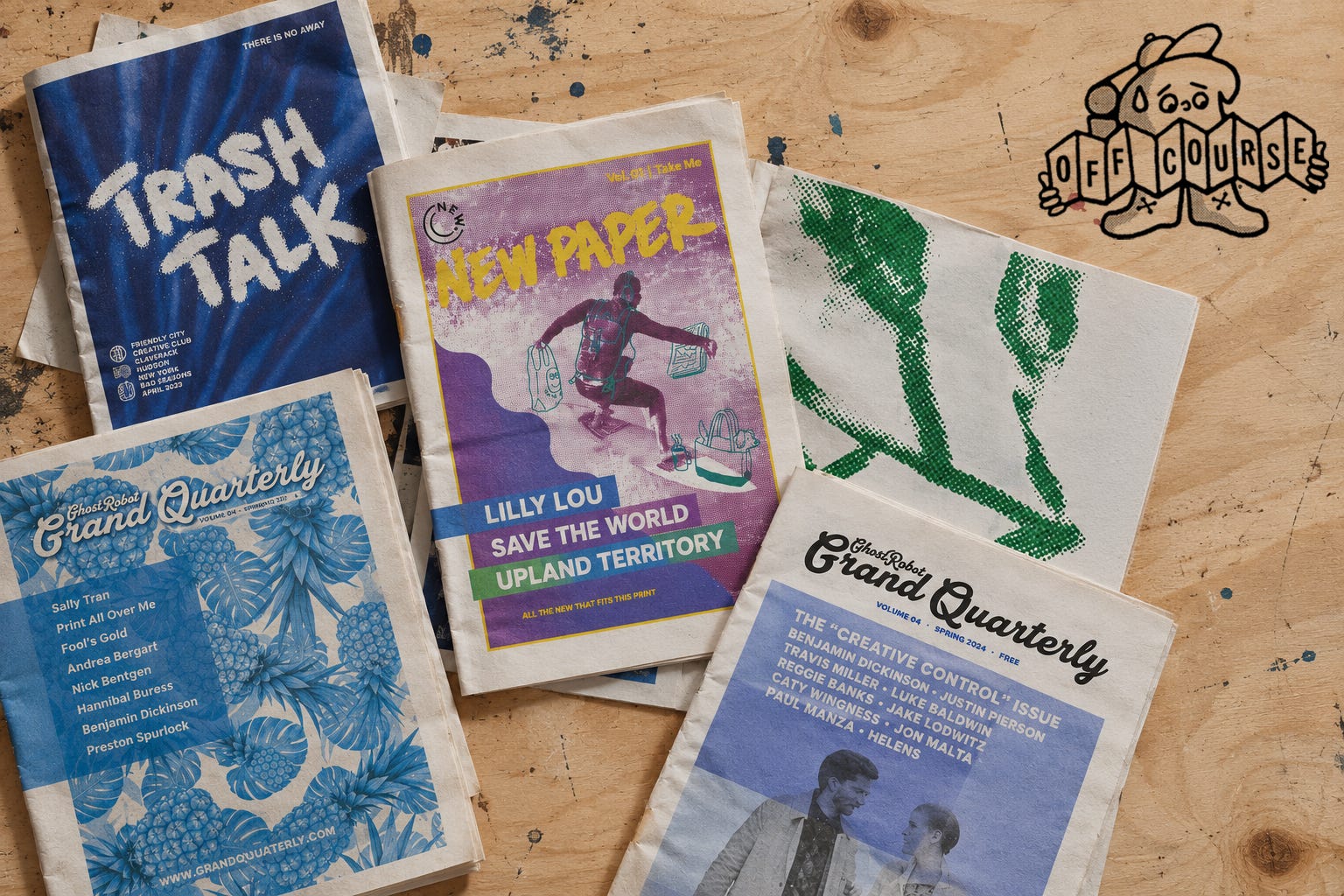
We put a little retail shop in the front of the office with Ghost Robot shirts, our famous knit caps, copies of graphic novels that Zach Mortensen was publishing at the time, and other objects and knick-knacks we liked. The idea was to curate the store a few times a year around a theme, create some new things, make a zine, and throw a party. A T-shirt would tell part of the story, an object would tell another part, the zine would connect the dots, and the party would bring people into the whole thing for a night.


We had some awesome parties. There was usually some new technology we were playing with, an artist whose work we liked, or some strange thing one of us had become interested in that we could find an excuse to put in front of people. Reggie Watts performed. Hannibal Buress was a collaborator. We had drag queen guitarists, dance troupes, a live interactive drawing competition, and augmented reality art. We started thinking about Ghost Robot less like a production company and more like a magazine. We were constantly curating and editing, looking for interesting things, putting them next to other interesting things, and trying to figure out what it all meant. The things we explored on our own had a funny habit of eventually finding their way into our client work.
The zines were my favorite part of all of this, and I fell in love with making them. I was never trained as a designer, and I certainly wouldn’t claim to be an expert in typography or print design. I just liked the puzzle. With a zine, the constraints are very obvious. You have a certain number of pages, a certain page size, and a certain amount of space. We were offset printing ours, so color was a very real consideration too. Every additional color meant another plate, another pass through the press, and more money. You can’t just make whatever you want. You have to figure out how creative you can be inside a very specific space.
One of my favorite music videos ever is for Papas Fritas, directed by Mike Mills. It’s a great song, and the video is incredibly simple. The concept is basically: let’s go to Central Park, wear these colorful jackets, and find as many interesting things to do as possible. Some minimal props and very basic animation round it out. That’s pretty much it, and it’s great. It has an energy and charisma that I don’t think could have been improved by giving them ten times the budget. There are countless music videos with more locations, more equipment, more effects, more people, and more stuff that aren’t half as memorable.
Zines are a perfect reflection of this philosophy. The stuff isn’t the idea. More pages don’t necessarily make something more interesting. More colors don’t make a design better. More locations don’t make a film better. More money can certainly give you more options, and there are plenty of times when more time or more money would make our work easier, but none of those things solve the creative problem for you.
Because we are cognitive misers, breakthrough creativity happens when the easy and intuitive path is blocked–by choice, or by force.
David Epstein, Inside the Box
We ended up making seven or eight zines for ourselves in Williamsburg. Eventually clients started asking us to make them too. We made one for the U by Kotex Period Shop, a pop-up store we created in New York. We made one for NYC Ferry with illustrated instructions in the corner showing you how to fold the zine itself into a paper boat, which remains my favorite unnecessary detail we’ve ever put into a client project.
When I opened Friendly City, my storefront studio in Hudson, I continued the tradition. We did an art show about trash and made a zine. We did a sticker show to raise money for Friends of Hudson Youth and made another one. We made a risograph program for a fundraising gala that was probably much more elaborate than a fundraising gala program needed to be. I’ve continued to find excuses to make them even though they’re not a particularly meaningful part of any business I’ve run. I’ve never made much money making zines, I have no formal qualifications to make them, and I’m not really sure anyone thinks of me as someone who makes them. Yet I would be very happy if someone paid me to make them all day.
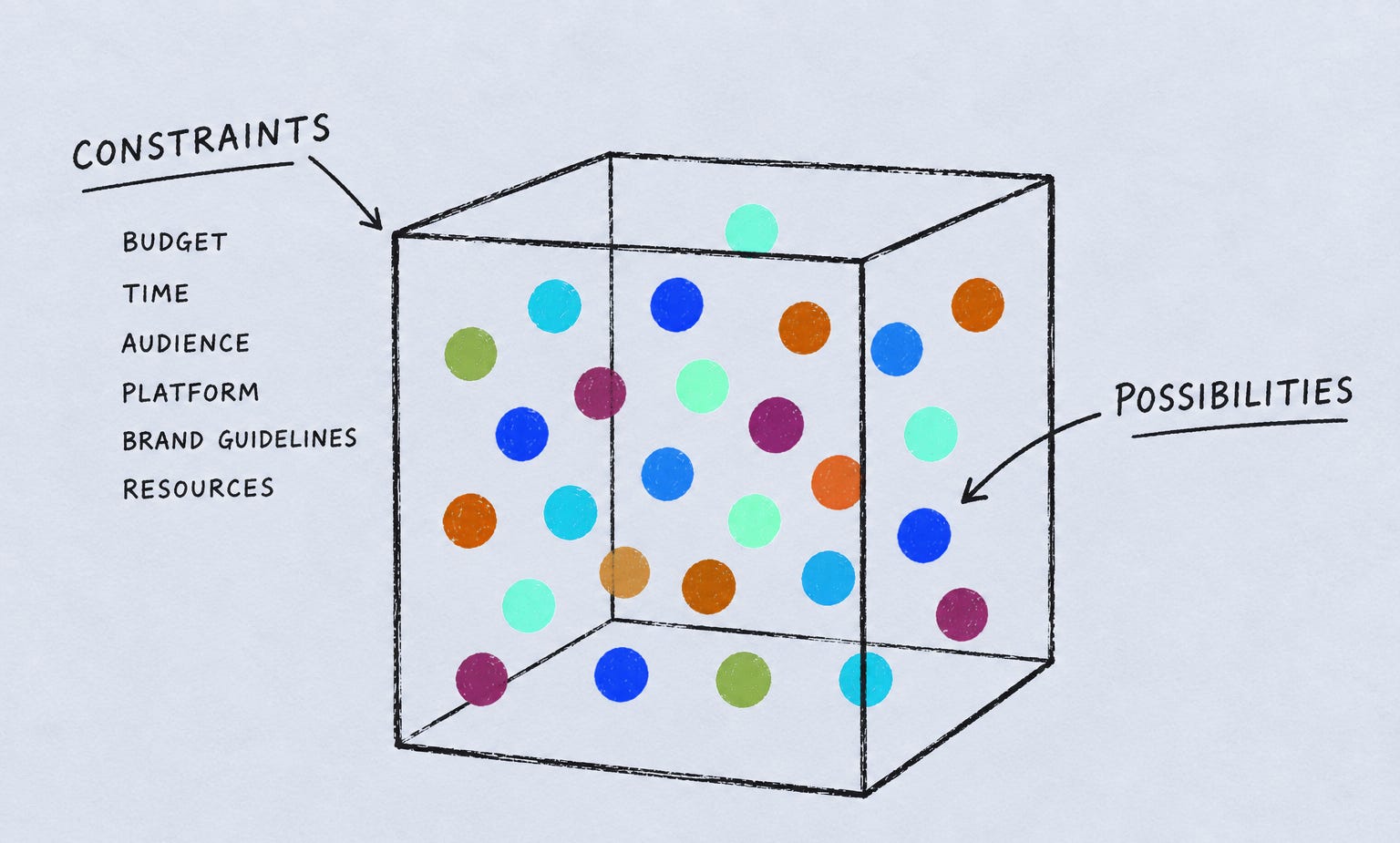
It’s because a zine is a pretty perfect metaphor for the kind of creative problem I like solving. Every project has a box around it. Sometimes it’s page count and paper size. Sometimes it’s a budget, a deadline, a media format, a client need, or the fact that you only have access to one location for six hours on a Tuesday.
For most creatives, the instinct is to make the box bigger. Bigger budgets, more time, more people, more options. [To be clear, I like all of those things too; please give us more money and more time.] But the box doesn’t go away. Our job is to recognize the constraints, define the box, and then explore every square millimeter of it.
The creative process should be like the DVD loading screen that The Office made famous. You bounce around inside the box, hit one wall, change direction, hit another wall, and keep going. Most of the time nothing particularly exciting happens. Occasionally you hit the corner perfectly, and everyone loses their mind.
Constraints aren’t something you need to get past before you can do the interesting work. Working with them is the interesting work.